
Turning Meaningful Comments into Standalone Posts


Context
This project started with a simple but strategic question:
Comments are already one of TikTok’s most natural and high-penetration expression surfaces, so could they become a pathway to broader content creation? What I found was that the opportunity was real, but the early model was not creating new content value. It felt more like forwarding than publishing. My work focused on redefining that model, so comment-to-post could become a healthier, more intentional creation pathway.
Background Information
With over 2 billion global users, TikTok is a leading user-generated content (UGC) video platform. Promoting meaningful UGC discussions and content creation is a long-term goal for TikTok.
Among all content formats, comments stand out in two key ways:
•
They have the highest user penetration (nearly 70%)
•
They carry the lowest barrier to expression
As a result, comments have become users’ most natural and frequent entry point for expression, and a critical starting point for driving community participation and UGC content supply.
Timeline
2025 June - Dec (6 months)
Role
Product Design Intern
Team
•
Product Foundation Design Team
•
Product, Development, and Quality Assurance Team

My Role & Design Direction
As the designer focused on the comments experience, I explored how comments could drive richer community discussions and the creation from 4 directions:
1.
Converting informational comments into posts
(This case study focuses on this direction)
1.
Comments often contain valuable insights, but remain confined to discussion threads.
1.
Unlock high-value comments as a new publishing pathway, turning everyday insights into standalone posts and expanding creation in the ecosystem.
2.
Surfacing high-value comments in the feed
2.
Some feed descriptions lack substance, leaving valuable space underutilized.
2.
This project surfaces high-value comments directly in the feed, turning them into entry points that attract users into deeper discussion.
3.
Exposing comment theme summaries in the feed
2.
Many meaningful discussions remain hidden in comment threads.
2.
This project surfaces discussion highlights in the feed, helping users discover engaging topics and join conversations earlier and creating a foundation for future AI-driven comment exploration.
4.
Converting passive interest into active replies
4.
When a user signals interest in a comment — for example, by liking it — there is a natural opportunity to encourage the next step.
4.
This project leveraged such engagement signals to surface contextual reply suggestions, guiding users from passive interest into active conversation.
Why Convert Comments into Posts?

Opportunity
High-value comments are created every day, but their value is often trapped within a single video thread.
Comments are one of the most natural entry points for expression and community participation.
Turning comments into posts allows valuable insights to scale beyond individual videos and contribute to the broader content ecosystem.
Expected Impact & Value
How converting comments into posts creates value across creators, consumers, and the community
For Commenters
CURRENT GAPS
Limited reach within single videos
Case reviews show that many comments contain answer-seeking questions or informational intent, but receive limited or no responses.
Gap between willingness to express and likelihood to publish posts
Among daily commenters, 69% never publish posts.
IMPACT
•
Expand reach and interaction for high-value comments
•
Break the barrier to first-time posting, and support continued creation within a positive expression loop
•
Foster Q&A-style posting behavior over time
For Consumers
CURRENT GAPS
High-quality comments often carry strong consumption value, sometimes even exceeding the original video itself
IMPACT
•
Enrich the UGC content structure (opinions, Q&A, experience sharing)
•
Improve overall content quality within the community
For Original Post Authors
CURRENT GAPS
----------------
IMPACT
Secondary distribution that extends reach and content lifespan


Previous Interaction Design Analysis

Lack of control before publishing
The publishing process happens instantly, with no preview, editing, or final confirmation step, making it hard for users to refine their content before posting.
Users had limited visibility into how their comment would become a post
The comment-to-post flow differs from users’ familiar posting patterns, making it unclear what type of content they are creating, where it will be published, and how it will appear or spread after posting.

Comment posts behaved like commentary, not new content
The original video remained the core asset, while the comment only added interpretation.
Result:
Limited new UGC value was generated — the format merely redistributed existing content, even may weakening users’ perception of overall content quality.
Previous Data Feedback Analysis
Low Engagement and High Deletion Rate
Quantitative Signals
•
During the experiment period, comment-to-post volume remained extremely low (posting penetration +0.33%).
•
Post-publish deletion rate increased noticeably (+1.11%).
Qualitative Signals
•
Comment-based posts felt more like forwards than original creations.
Insights
High deletion likely indicates unclear expectations before publishing.
Posting felt casual like forwarding, while the final post outcome was unclear before publishing.
Ecosystem Risks
Impact on Original Creators
Comment-to-post publishing may compete with original content for attention and reduce exposure for original creators and posing risks to TikTok’s creator ecosystem.
Opportunity
Encourage more independent creation
Guide comment-based posts toward more original expression rather than feeling like forwards.
Content Value Dilution
The low creation cost of comment-to-post publishing may encourage an increase in low-effort submissions.
In A/B test, no significant negative metric shifts were observed. However, long-term quality risks remain a concern:
Encourage more structured creation
Introduce editing and content organization to reduce low-effort submissions.
Highlight new UGC content in the player
Adjust the player layout to better support text-dominant content.
Risk of Amplifying Negative Behavior
Once emotional, aggressive, or inflammatory comments are converted into posts and enter the distribution pipeline, they may amplify existing issues within the comment ecosystem and negatively affect community tone.
Current case reviews did not reveal clear amplification of negative behaviors. However, potential risks remain:
Establish guardrails for comment-to-post eligibility
Control conversion triggers and distribution thresholds to prevent harmful comments from scaling.
1️⃣
Entry:
When should a comment become a post?
•
Elevate only high-value comments
•
Reduce noise and protect feed quality
2️⃣
播放器样式:
How should comment-based posts appear in the feed?
•
Make them feel like independent content
•
Establish a clear and consistent consumption pattern
3️⃣
Interaction Flow:
How can publishing stay lightweight yet structured?
•
引导用户将内容编辑的更完整
•
发布流程中尽可能地减少摩擦
Trigger: Exploring Entry Moment for Converting Comments Into Posts
Design Brief
Converting comments into posts have a series of potential opportunities embedded throughout the commenting user journey.
I identified 4 distinct touchpoints to introduce a “comment to post”.
For each entry point, I explored multiple design options, evaluated their trade-offs, and determined whether and how a “comment to post” entry should exist in that context.
Entry Point 1: After Comment Is Published
Why this entry point?
After a comment is published, both user intent and content quality become observable. This makes it an ideal moment to evaluate whether a comment is suitable for post conversion.
Compared to earlier approaches, the “Add as Post” entry is surfaced only when a comment demonstrates clear publishing value — such as seeking answers, providing useful information, sharing insights, or recounting personal experiences — filtering out unsuitable content and reducing the risk of amplifying low-quality or harmful posts.
Design Explorations

Design Decision
Given that this feature is currently in an early stage, visibility and discoverability were prioritized. As a result, Option 2 (Distinct Button) was selected to better surface publishing intent and support initial user adoption.
Once the feature matures and user behavior stabilizes, the entry may gradually evolve toward a more subtle and system-integrated pattern.
Entry Point 2: During Comment Composition
Why this entry point?
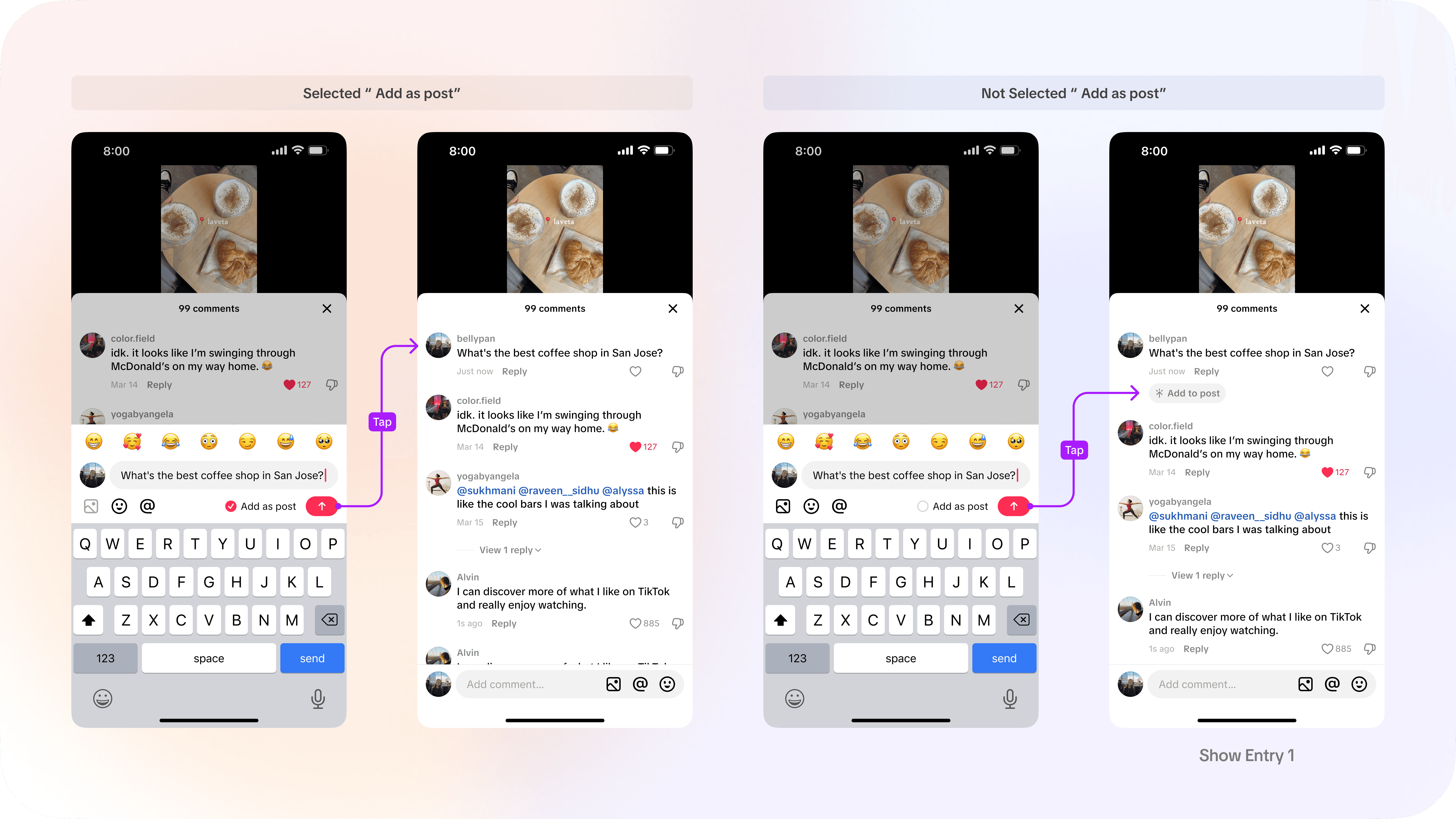
Exposing the “Add as post” entry during comment composition explores whether early visibility of publishing intent can encourage users to treat certain comments as more complete, public-facing expressions. By surfacing this possibility upfront, users may invest more effort in structuring and refining their responses.
Design Decision
This was not the right moment to introduce this entry point, so it was not advanced to testing.
At this stage, users had not yet formed a stable mental model for turning comments into posts. As a result, surfacing the entry during composition was often experienced as noise rather than guidance, making it unsuitable as a persistent entry point.
Entry Point 3: Inbox Surface for High-Engagement Comments
Why this entry point?
This entry uses post-comment engagement signals—such as likes and replies—as external validation of a comment’s public value.
When a comment demonstrates sustained interaction, a conversion entry is surfaced in Inbox to invite broader sharing.
Design Explorations

Design Decision
Option 1 was chosen to prioritize system trust over short-term conversion gains.
Through a design review with the Inbox design team, we aligned that while high-engagement comments signal strong public value, Inbox is not an action-primary surface. A low-interruption entry better respects existing notification expectations, reducing CTA fatigue and preserving the integrity of the Inbox experience.
Entry Point 4: Resurfacing High-Value Comments That Were Never Posted Through Notifications
Why this entry point?
Some high-value comments are never posted because the moment has passed or was forgotten.
This entry periodically resurfaces select high-value comments using conservative frequency and eligibility rules, creating a low-pressure re-engagement path for informational and help-seeking content.
Design Explorations

Design Decision
This entry point was approved through design review with strict eligibility and frequency constraints.
Notifications are treated as a scarce system resource and are only used to resurface comments with clear public value or unresolved information needs. By framing the entry as a reminder rather than a prompt, this approach amplifies valuable content while preserving user attention and notification trust.
播放器样式: Redesign how comment-based posts are presented
Previous Failed Consumption Expeience
The original video dominated the visual space, with comments treated as secondary context.
As a result, user attention remained anchored to the original video, preventing comments from being perceived as independently consumable UGC content.
This Iteration

Comment-first design
Comments designed as standalone UGC, not extensions of the original video

Video as contextual reference
Original video provides context, not focus

Precieving as a new content type
Stable mental model for consistent consumption pattern.
Design Explorations
Rather than committing to a single layout solution upfront, I explored multiple player templates with varying levels of original content prominence to understand when comment-based posts could remain meaningful on their own, clarifying which presentation weights are viable given current model capability and user readiness.

To ground this decision in reality rather than ideal assumptions, I structured an internal design review using model-selected, potentially publishable comments across different presentation weights.
Design and product team reviewed these comments by placing them into templates with varying levels of original content prominence, assessing perceived independence, clarity, and publishability.

Shared Challenge
Comment Quality
Some model-selected comments still relied on the original content for full comprehension.
We Got Diverging Perspectives:
Design Team
For an initial launch, we prioritized baseline comprehension.
Rather than removing the original content entirely, we recommended keeping it visually present but clearly minimized—using low yet perceivable reference weight—so users could understand context while gradually forming a mental model for comment-based posts before moving toward stronger independence.
Product Team
The product team aimed to validate the most aggressive version of the concept early.
They proposed removing the original content entirely from the template and exposing it only as a link in the description.
The goal was to identify the upper boundary of this content format.
Design Reframe: Rather than enforcing a single presentation rule, I reframed the problem at a design strategy level
Instead of having the system decide upfront whether a comment is “independent enough,” I explored returning that decision to creators. Creators are often the best judges of how complete their expression is, and can make more informed choices at the moment of publishing.
This led to a flexible template strategy with two options:
•
Templates with original content reference
•
Text-only templates, without visually displaying the original content
This approach allows the system to support different levels of content maturity without overfitting to a single rule, while remaining flexible to current model limitations and future evolution of comment-based posts.

Design Decision
Following this strategy, we finalized a hybrid launch approach for the current phase. It ensures comments remain understandable at launch, while leaving room to validate stronger forms of independent expression.
Additional Visual Explorations (Capability Exploration · Not Part of the Final Decision)
Visual Style Exploration
Beyond the core design decisions, I explored a range of visual styles for comment-based posts to understand the expressive potential of the format.
These explorations introduced more playful, lifestyle-oriented visual treatments to test how far the presentation could be pushed without hurting comprehension.
At the current stage, these directions were intentionally deprioritized to avoid distracting from the primary goal of establishing a clear and stable user mental model. They remain valuable references for future expansion once the format matures.


Early Interaction Experiments
I also experimented with lightweight interaction patterns—such as card flipping and stacking—to explore whether interaction could help bridge context between comments and their original content.
Similar to visual style exploration, these interaction concepts were paused in favor of prioritizing clarity and mental model formation in the initial launch phase.
Revisiting a Failed Direction with Reframed Content Hierarchy
I revisited a previously unsuccessful direction by restructuring content hierarchy. This exploration elevated comment text to primary content, while reducing the original video to a secondary reference.
This round of exploration reinforced that, at the current stage, clear content hierarchy and weighting outweigh visual or interaction novelty, providing early validation for the player-weighting decisions discussed earlier.

Interaction Flow: Comment-to-Post Creation Flow Exploration
Problem Framing
How might we keep the publishing flow lightweight while giving users a clear sense of control and guiding them to create content that feels complete enough to stand on its own?
Direction 1: Edit-First Flow (More Guided)
This approach prioritizes expression completeness by guiding creators to revise their comment before previewing the final post.
Trade-off
•
Users may be less motivated to edit before they can see the final output.
•
Introduces additional friction in the publishing flow

Direction 2: Preview-First Flow (More Lightweight)
This approach allows creators to see the final post immediately, minimizing friction, low perceived effort and keeping momentum high.
Trade-off
•
Less signal toward refining the text
•
Higher risk of publishing comments that rely too heavily on original context

Addressing the Core Weakness
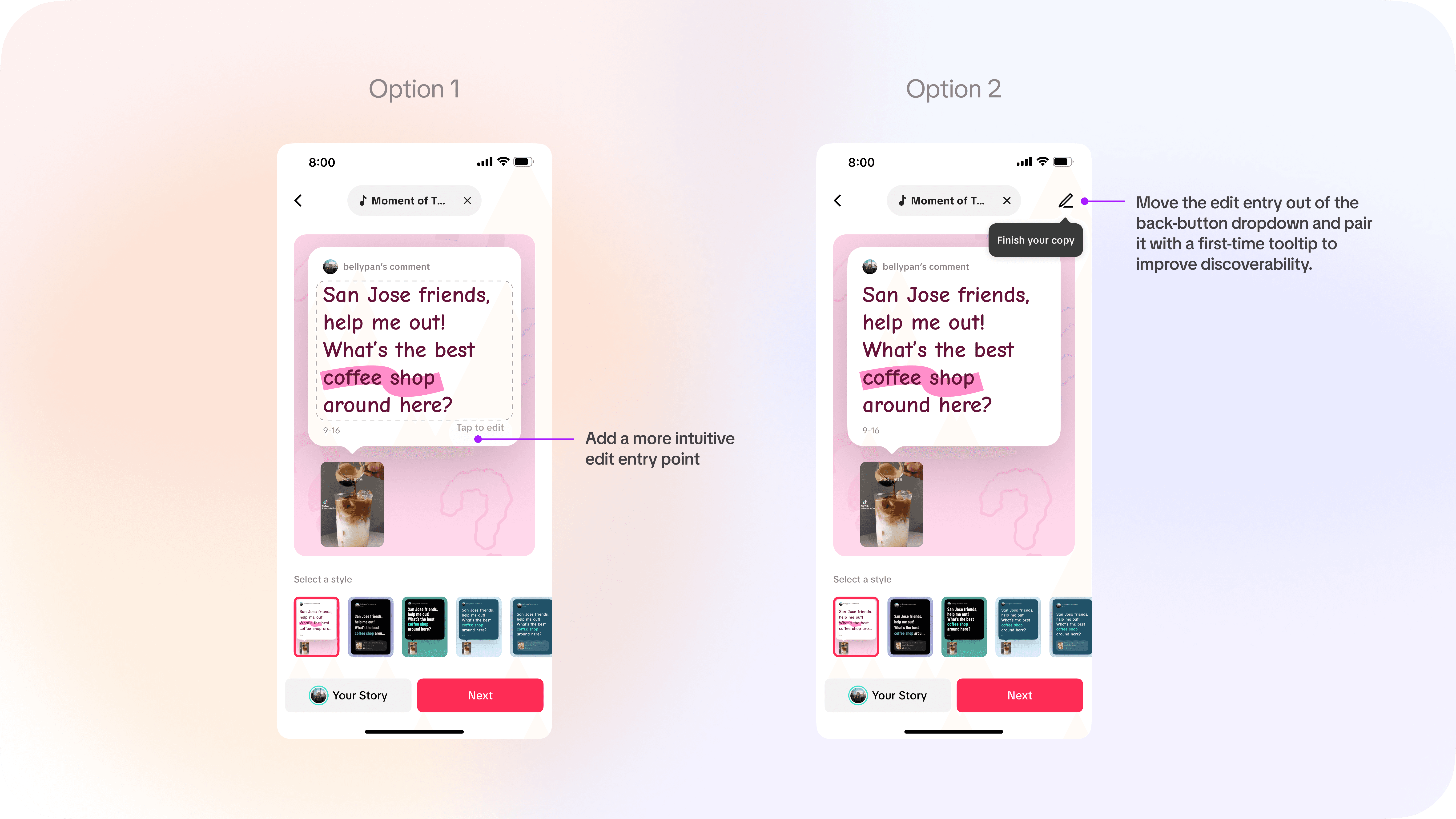
Rather than abandoning the preview-first approach, I explored lightweight design interventions that encourage editing without interrupting the fast, low-friction flow.
Design Insight
Seeing the final post first often makes creators more willing to revise their text, rather than editing in abstraction.
This reinforced the idea that preview-driven motivation can be a viable way to balance speed and expression quality—especially in early-stage content formats.
Design Decision
We chose Direction 1, keeping text editing as a required step in the creation flow.
This decision balances three constraints:
•
Technical limitations disrupted the interaction flow: Direct template loading introduced noticeable performance latency.
•
Leading with text editing creates a more stable flow over time and helps users build a clearer mental model of the feature.

At the early stage of exploration, I organized an early Design Sprint and invited members of the design team to participate in an open brainstorming session.
Through these discussions, I was able to rapidly expand the problem space while also accelerating the identification and convergence of key design directions.
These early collaborative explorations laid an important foundation for the design strategy that followed, providing clearer decision-making signals and shaping how the problem was ultimately framed.

The next phase of this work prioritizes validation over expansion—focusing on whether the current design decisions can scale sustainably while preserving creator confidence and content quality.
Validate expression quality, not just conversion
Assess whether published comment-based posts become increasingly self-contained and intentional, rather than relying on original video context or impulsive publishing behavior.
Evaluate whether guidance reduces post-publish regret
Examine signals such as edit depth, deletion behavior, and time-to-publish to understand whether the flow helps users feel ownership and confidence over what they share.
Assess ecosystem impact before scaling distribution
Before expanding reach, validate how comment-based posts affect overall feed quality, creator incentives, and the balance between original content and derivative expression.